

close
Choose Your Site
Global
Social Media
Views: 0 Author: Site Editor Publish Time: 2026-07-23 Origin: Site


The physical configuration of cooking equipment dictates kitchen workflow, safety compliance, thermal management, and long-term maintenance overhead. Buyers must choose between committing floor space to a freestanding unit or sacrificing counter space for a portable unit. This decision directly impacts gas line routing, kitchen ambient temperatures, ventilation requirements, and upfront infrastructure modifications. Selecting the right equipment requires looking beyond basic burner counts. You must evaluate how the appliance integrates with your existing architecture and daily operational volume. A heavy-duty unit alters the thermal dynamics of the room, while a compact unit changes how you utilize your preparation surfaces. This guide provides a direct, feature-to-outcome comparison between a Gas Stove with Stand and a tabletop gas stove. We evaluate both configurations on stability, installation realities, and spatial efficiency to facilitate a confident, technically sound purchasing decision.
Space Allocation: A gas stove with stand requires dedicated floor space and specific side clearances, while a tabletop gas stove requires heat-resistant countertop real estate.
Safety and Stability: Stoves with integrated stands offer superior stability for heavy-duty cookware, whereas tabletop models introduce slight risks of shifting if not properly secured or placed on non-slip surfaces.
Thermal Impact & Ventilation: Both configurations emit combustion byproducts (like nitrogen dioxide) and increase ambient kitchen temperatures, but higher-BTU stand models necessitate more aggressive, fixed overhead ventilation and higher HVAC cooling considerations.
Installation Complexity: Stand-mounted stoves often require rigid gas line installations and dedicated ventilation hoods; tabletop units typically utilize flexible gas hosing, offering modularity but requiring strict adherence to local gas safety codes.
A freestanding gas cooker operates as a unified appliance where the burners integrate directly into a structural metal frame. We typically see these frames constructed from cast iron or heavy-gauge stainless steel. They sit directly on the floor, bypassing the need for base cabinets. Many designs include lower storage shelves for heavy pots or an integrated oven compartment. The structural integrity of the frame supports significant weight. This makes it highly suitable for large-batch preparation and heavy stockpots.
The primary success criteria for this configuration include high heat output, structural durability for heavy loads, and the creation of a centralized cooking zone. By anchoring the cooking station to the floor, you isolate intense heat and mechanical stress from delicate wooden cabinetry. This setup excels in environments where aggressive cooking techniques are standard practice. When you drop a 40-quart stockpot onto the grates, the floor absorbs the impact, not your expensive countertops.
Field experience shows that these units require precise floor leveling. If the floor pitches even a quarter inch, the entire frame sits out of plumb. This causes oils to pool on one side of your pans. Installers must use heavy-duty leveling shims or adjustable steel feet to dial in the exact height. You also need to account for the physical footprint. A standard unit demands at least 24 to 36 inches of dedicated linear floor space, plus mandatory side clearances to combustible walls.
A countertop unit functions as a low-profile, standalone burner system. You place it directly on an existing kitchen counter, island, or heavy-duty prep table. This configuration remains distinct from built-in gas hobs. Built-in hobs require permanent cutouts in the countertop material. Tabletop units prioritize modularity. You can relocate them easily if the gas connection permits and local codes allow flexible hose movement.
The primary success criteria here are a minimal footprint, ease of relocation, and seamless integration into existing cabinetry. You do not need to execute structural modifications to your kitchen layout. These units serve well in spaces where preserving lower storage drawers is critical. They allow users to add high-performance gas cooking to a space without tearing out base cabinets.
However, you must evaluate the surface material beneath the unit. We often see heat damage on laminate counters when users operate high-BTU tabletop burners for extended periods. The downward radiant heat requires a thermal barrier. If you place one of these units on a quartz counter, the localized heat can actually melt the binding resins in the stone over time. You must use high-density silicone mats or stainless steel heat shields under the unit to protect the work surface.
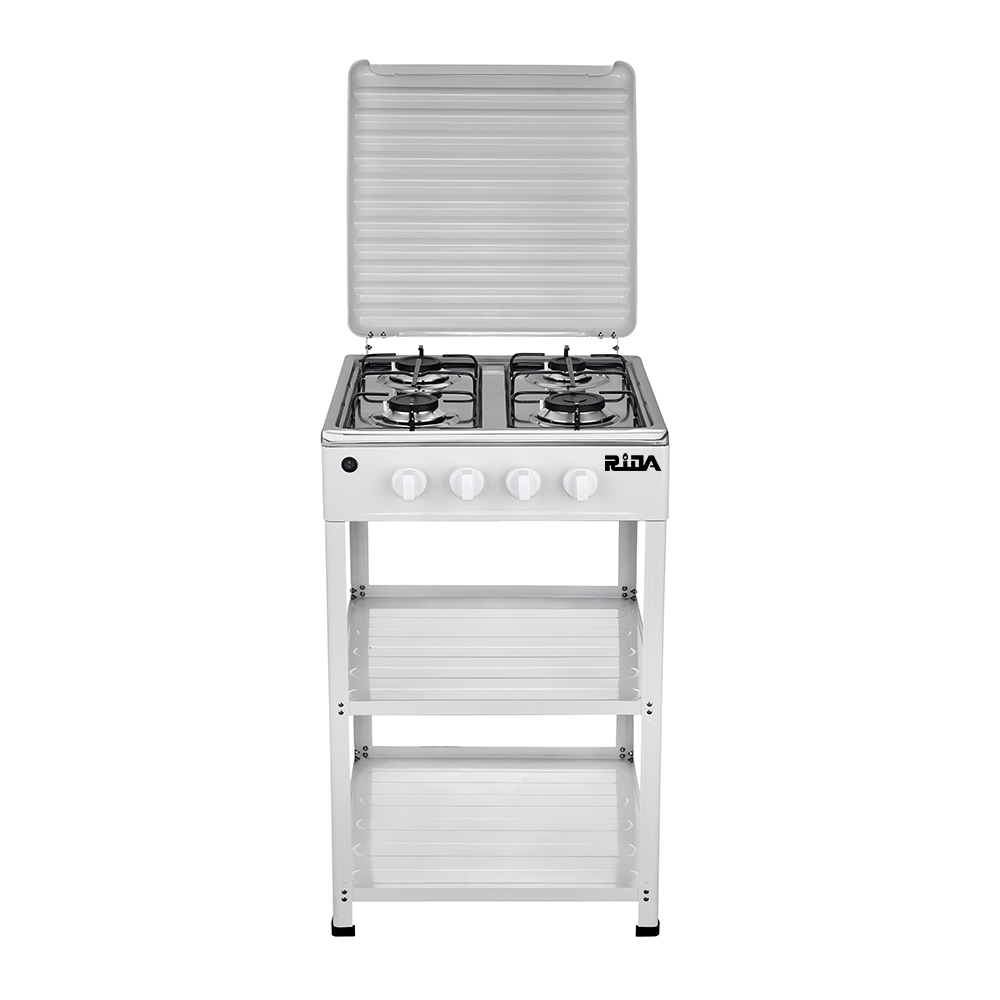
Deploying a freestanding unit eliminates the need for lower cabinetry in that specific zone. This configuration proves ideal for kitchens with available floor space but limited continuous counter space. By moving the cooking surface off the counter, you free up valuable real estate for food preparation, plating, and staging. The integrated lower shelves often compensate for the lost cabinet space by providing immediate access to heavy cookware.
Conversely, countertop models conserve floor space but consume critical prep areas. Placing a burner unit on your counter requires a careful ergonomic assessment. You must evaluate the counter height combined with the height of the stove and the cookware. Standard counters sit at 36 inches. If you add a 6-inch tall tabletop stove and a 12-inch tall pot, the cooking surface jumps to 54 inches. This forces the user into an uncomfortable shoulder position when stirring thick liquids or lifting heavy lids.
We recommend mapping out your workflow before committing. Use painter's tape to outline the exact dimensions of the unit on your counter or floor. Walk through your standard cooking motions. If the tabletop unit blocks your primary chopping station, it will bottleneck your daily operations. If the freestanding unit blocks a high-traffic walkway, you create a severe burn hazard.
Freestanding models feature heavy-duty construction designed to withstand high-impact cooking. Cast iron grates and structural steel frames prevent tipping or shifting during aggressive techniques. When you slide a heavy pan across the grates, the mass of the unit and its floor anchor keep the cooking surface completely stationary. This stability is a critical safety factor when dealing with gallons of boiling liquid.
Countertop models rely on rubberized feet and the friction of the counter surface to remain stable. Manufacturers frequently construct these units with tempered glass tops or thin-gauge stainless steel to reduce weight. While these materials are easier to wipe down, they remain more susceptible to damage from heavy impacts or severe thermal shock. If a heavy pot slips from your grip, a glass top will shatter instantly. A cast iron frame will merely scratch.
Let's look at the gauge of the steel. Freestanding units often utilize 16-gauge or 14-gauge stainless steel for the main chassis. This resists denting and warping under extreme heat. Tabletop units often use thinner 20-gauge or 22-gauge steel. Over time, the repeated heating and cooling cycles can cause thinner steel to warp, which compromises the level cooking surface and puts stress on the internal gas manifold.
Engineers typically design freestanding models for higher BTU output. The integrated stand acts as a thermal buffer between the intense heat of the burners and the floor. However, this high heat generation significantly increases the ambient temperature of the kitchen. Operating multiple high-BTU burners simultaneously demands robust climate control and can strain standard residential cooling systems.
Countertop models generally offer lower to mid-range BTUs. While they generate less ambient heat, they require strict evaluation of the underlying countertop material. Prolonged exposure to downward radiant heat can damage certain surfaces. Quartz, laminate, and wood countertops may suffer discoloration, warping, or resin melting over time if the stove lacks adequate heat shielding on its base.
Technical Specification | Freestanding Stand Model | Countertop Tabletop Model |
|---|---|---|
Typical BTU Range (Per Burner) | 15,000 - 30,000+ BTU | 7,500 - 15,000 BTU |
Structural Load Capacity | 100+ lbs (Supports massive stockpots) | 30 - 50 lbs (Standard residential cookware) |
Gas Line Requirement | Rigid black iron or heavy-duty CSST | Flexible appliance-rated gas hose |
Clearance to Combustibles (Sides) | 6 to 12 inches minimum | 2 to 4 inches (varies by manufacturer) |
Ventilation Demand | High CFM ducted hood required | Standard residential hood sufficient |
Installing a freestanding unit requires precise placement of the wall or floor gas stub. Because these units are rarely moved once installed, they often utilize rigid black iron piping or heavy-duty corrugated stainless steel tubing (CSST) hidden behind the frame. Local building codes strictly regulate how these connections are made. You must install a dedicated shut-off valve within immediate reach of the appliance, usually on the wall directly behind or beside the unit.
Countertop models require routing a flexible gas hose from a nearby supply valve to the counter surface. This introduces specific risk mitigation requirements. You must ensure the flexible hose is not pinched behind heavy appliances, exposed to direct radiant heat, or stretched beyond local code limits. Passing a flexible gas line through cabinet walls often requires protective rubber grommets to prevent the wood from abrading the hose over time.
We see many installation failures where users use the wrong diameter gas line. If you run a 3/8-inch line to a high-output freestanding unit, you will starve the burners of fuel. The flames will sputter and burn yellow, creating excess carbon monoxide. Always verify the manufacturer's required gas line diameter, which is typically 1/2-inch or 3/4-inch for larger units. You must also verify the gas pressure. Natural gas typically runs at 4 to 5 inches of water column, while liquid propane runs at 10 to 11 inches. Using the wrong regulator will cause catastrophic equipment failure.
High-output burners emit significant combustion gases, including nitrogen dioxide and carbon monoxide. A freestanding unit demands a dedicated, high-CFM (cubic feet per minute) ducted range hood directly above the cooking surface. Recirculating hoods are entirely insufficient for this application. The ductwork must vent directly to the exterior of the building to maintain safe indoor air quality.
To calculate the required CFM for a freestanding unit, divide the total BTU output of all burners by 100. If your unit produces 60,000 total BTUs, you need a hood capable of pulling at least 600 CFM. If you install a hood over 400 CFM, most building codes require a makeup air unit to prevent depressurizing the building and pulling exhaust gases back down the chimney.
While countertop units still require adequate ventilation, their lower BTU outputs may allow for standard residential hoods or high-efficiency downdraft systems. Regardless of the configuration, you must pair any indoor gas appliance with carbon monoxide and natural gas safety detectors placed nearby. Proper cross-ventilation remains a mandatory safety practice. Never operate these units in a sealed room without mechanical exhaust.
Cleaning a freestanding unit involves sweeping and mopping under the structural stand. Grease traps and drip pans are usually larger and integrated directly into the frame. You must manually remove and soak these components in heavy-duty degreasers. The heavy cast-iron grates require regular seasoning with high-smoke-point oils to prevent rust and maintain a non-stick surface. If you neglect the cast iron, the moisture from cooking will cause deep pitting.
Countertop models are generally easier to wipe down across the immediate surface, especially glass-top variants. However, grease and food particles inevitably accumulate in the tight seam between the base of the stove and the countertop. If you do not regularly disconnect the unit, move it, and thoroughly clean underneath, this area becomes a severe sanitation hazard. Pests are highly attracted to the grease buildup hidden beneath the chassis.
Burner port maintenance is critical for both configurations. Over time, boil-overs clog the small brass ports where the gas exits. You must use a stiff wire brush and a specialized port cleaning tool to clear these obstructions. If the ports clog, the gas velocity changes, resulting in uneven heating and dangerous flare-ups. We recommend a full teardown and deep clean of the burner manifolds every six months for heavy users.
Select this configuration for high-volume cooking or the regular use of heavy, large-capacity cookware. If your routine involves canning, brewing, or managing massive stockpots, the structural stability of a floor-anchored frame is mandatory. The high heat output ensures rapid recovery times when adding cold ingredients to large volumes of liquid.
This setup also suits kitchen renovations where floor space is abundant but continuous counter space is at a premium. By removing the stove from the counter, you maximize your prep zones. Environments where maximum structural stability and high-BTU output are non-negotiable should always default to a freestanding frame. It handles the physical abuse of daily heavy cooking without transferring stress to your cabinetry.
Countertop models are the optimal choice for temporary kitchen setups, outdoor kitchenettes, or spaces requiring modularity. Because they do not require permanent cabinetry removal, they offer flexibility for spaces that may undergo future layout changes. You can easily disconnect and relocate them, provided the gas infrastructure supports it.
Specify this configuration in compact kitchens or Accessory Dwelling Units (ADUs) where preserving floor space for lower cabinetry and deep drawers is critical. For projects where avoiding destructive cabinetry modification is a priority, a countertop unit delivers immediate cooking capability with minimal structural disruption. Just ensure your counter material can handle the localized heat.
Measure your exact floor width and continuous counter depth to determine which configuration physically fits your layout without blocking walkways.
Verify the diameter, pressure type, and location of your existing gas supply line to ensure compatibility with your chosen unit's manifold.
Calculate your required ventilation CFM based on the total BTU output of the appliance and confirm your current hood meets this specification.
Inspect your countertop material for heat resistance if selecting a tabletop model, and purchase a certified thermal barrier mat if necessary.
A: A tabletop unit rests entirely on top of the counter and can be moved by simply disconnecting the gas line. A built-in gas hob requires a permanent, custom-sized cutout in the countertop material and is permanently secured into the cabinetry structure.
A: While physically possible, it is not recommended. Countertop units lack the integrated thermal shielding required for open-air stands, and custom fabrication may void the manufacturer's warranty and violate local fire safety codes.
A: They can be used, but require strict caution. Prolonged downward radiant heat can scorch laminate or melt the resins in quartz. Always verify the manufacturer's required bottom clearance and consider using a certified heat-resistant mat.
A: Yes, freestanding units typically require rigid black iron piping or heavy-duty CSST connected directly to a wall stub, whereas countertop units often utilize flexible, appliance-rated gas hoses for easier routing.
A: Clearance requirements vary by manufacturer and local codes, but typically demand 6 to 12 inches of space between the burners and any combustible side walls, along with a minimum of 30 inches of vertical clearance to unprotected overhead cabinets.
A: Generally, yes. Freestanding models are engineered with larger burner manifolds to support high-volume cooking, while countertop models are restricted by their compact size and the thermal limitations of the surfaces they rest upon.


