

close
Choose Your Site
Global
Social Media
Views: 0 Author: Site Editor Publish Time: 2026-10-15 Origin: Site


Upgrading kitchen appliances demands a careful balance of precision and speed. Current design trends heavily favor maximizing both aspects simultaneously. This demand has driven the rising popularity of the built-in cooker. It is an innovative piece of equipment that merges visual flame control with rapid induction boiling. However, this dual-fuel capability creates a common point of confusion during renovations. People frequently ask how to safely power a unit that relies on both combustible gas and high-voltage electricity.
Looking at recent industry developments, the kitchen appliance market is undergoing a massive electrification phase. Yet, legacy infrastructure in many regions still relies heavily on natural gas grids. Hybrid models act as a vital transitional bridge. Market analysts note a sharp increase in demand for dual-fuel systems because they offer unparalleled grid resilience. If the power goes out, the gas burners still function manually. If gas prices spike, the induction zones take over. This dual-nature design fundamentally alters residential wiring requirements.
This guide breaks down the wiring architecture and electrical requirements from a field engineering perspective. Understanding this underlying framework is critical for a safe and compliant setup, whether you are planning a complete kitchen overhaul or swapping out an older unit.
Key Takeaways
Dual Power Architecture: A hybrid unit uses a 120V internal distribution for the gas spark ignition and a 240V connection for the heavy induction heating elements.
Dedicated Circuitry: Induction coils draw immense power. Most hybrid models demand a dedicated 20-amp to 50-amp circuit to prevent tripped breakers and fire hazards.
Smart Features Integration: Advanced units require flawless electrical grounding. Poor grounding causes static interference, making digital control panels unresponsive.
Utility Separation: Electrical codes mandate strict spatial clearance between the combustible gas supply line and the high-voltage junction box.
Understanding the installation begins with analyzing the internal hardware. A hybrid appliance is an engineering marvel. It merges two entirely different thermal generation methods into a single chassis. Standalone units rely on a single utility. A hybrid model bridges combustible gas delivery and electromagnetic energy transfer. This alters how the appliance connects to a residential electrical grid.
To comprehend the wiring, we must look inside a gas electric cooktop. The appliance is divided into two distinct functional zones.
The gas side is heavily mechanical. Picture cast-iron grates sitting above physical brass valves and manifolds. Electrically, these burners pull almost zero load. They only need power for the spark ignition module. This small block generates a high-voltage arc to ignite the raw gas. It runs on standard 120-volt alternating current and draws less than a single amp.
Conversely, the induction side is highly power-intensive. Induction cooking relies on tightly wound copper coils positioned beneath the glass surface. Passing electricity through these coils creates a rapidly alternating magnetic field. This field induces eddy currents inside magnetic cookware, generating heat directly within the metal. Boiling water in seconds requires a massive energy draw. These coils need a 240-volt power supply and can pull anywhere from 2,000 to 7,000 watts depending on the configuration.
Manufacturers manage these extreme power requirements through a single external power cable. Inspecting the flexible wiring whip extending from the bottom of the appliance reveals a standard 240V setup. Inside the chassis, a power distribution block splits the incoming current. The raw 240V power routes directly to the heavy-duty relays controlling the induction coils. Meanwhile, a neutral wire or internal step-down transformer isolates 120V for the delicate components. This lower voltage safely runs the ignition module, cooling fans, and microprocessors.
Verifying that your electrical panel can support the load is the most critical phase of preparation. Failing to meet voltage and amperage specifications results in poor performance or severe electrical hazards.
In North America, standard units require a 240-volt or 208-volt single-phase supply. Amperage is the critical factor. The required amperage correlates directly to the number of induction zones. Based on standard 75cm to 90cm hybrid models, the power draw scales significantly.
Appliance Configuration | Typical Induction Wattage | Required Dedicated Breaker | Required Copper Wire Gauge |
|---|---|---|---|
Compact Hybrid 2 Gas, 1 Induction | 2,000W - 3,000W | 20 Amp Double-Pole | 12 AWG |
Standard Hybrid 2 Gas, 2 Induction | 3,500W - 4,500W | 30 Amp Double-Pole | 10 AWG |
Heavy Duty 1 Gas, 4 Induction | 7,000W - 9,000W | 40 to 50 Amp Double-Pole | 8 to 6 AWG |
Pushing high amperage generates significant heat within wall wiring. Using the correct American Wire Gauge is a strict safety requirement. The lower the gauge number, the thicker the wire, allowing it to carry more current safely.
Wrestling stiff 8-gauge copper wire inside a cramped cabinet tests your patience. Always use pure copper wiring. Connecting legacy aluminum house wiring directly to the appliance's copper whip causes galvanic corrosion. This creates immense electrical resistance and a severe fire risk. Specialized anti-oxidant connectors must be used by a licensed electrician if aluminum wiring is present.
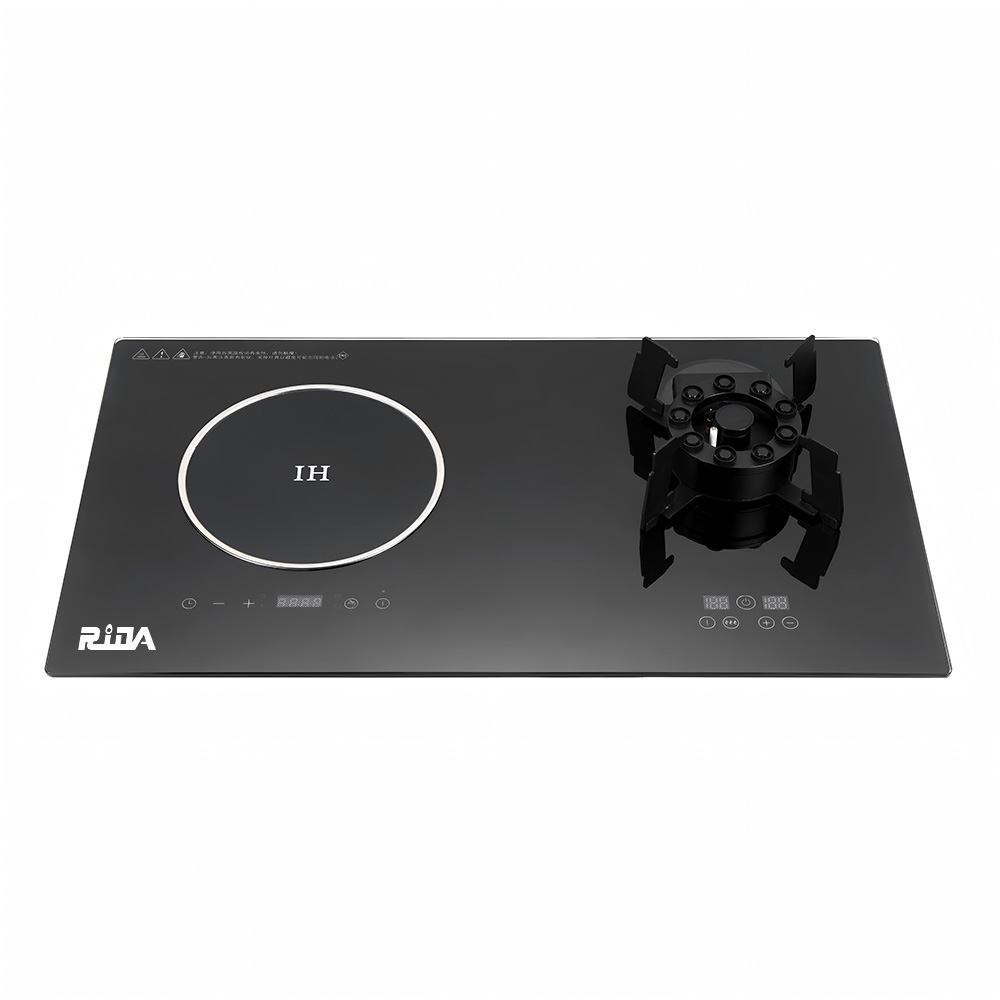
Modern units often feature a touch screen hob. These capacitive glass interfaces demand a highly stable power supply. A mechanical gas valve simply opens when turned. A digital control board relies on sensitive microprocessors.
Activating a high-powered induction burner creates a momentary surge in electrical demand. An undersized circuit will cause a micro-voltage drop. A traditional resistance coil ignores this dip, but a digital interface might experience a brownout. The screen could reboot, flicker, or throw error codes. Properly sizing the dedicated circuit guarantees clean, uninterrupted power to the smart controls.
Grounding is non-negotiable. Capacitive screens detect the minute electrical capacitance of a human finger. Without a robust Equipment Grounding Conductor, stray voltage accumulates on the metal chassis. This causes ghost touches where burners activate themselves due to electromagnetic interference. Proper grounding stabilizes the digital sensors and provides a safe path for fault currents.
Housing explosive gas and high-voltage electricity in one confined cabinet requires strict spatial planning. Field execution must be meticulous.
Induction components generate significant internal heat. They rely on integrated cooling fans to push this heat downward. The wiring conduit and junction box must be routed away from the bottom heat sink. Manufacturers specify minimum clearance requirements below the unit to ensure airflow. Blocking this ventilation trips thermal overload sensors, shutting the unit down to prevent melting.
Best practices dictate keeping the flexible gas line and the armored electrical cable physically separated. Never zip-tie them together. Cabinet vibration and ambient heat transfer could compromise the electrical sheathing or the gas line structure over time. Securing them to opposite sides of the cabinet interior is the safest approach.
Wiring high-voltage equipment requires strict adherence to building codes. Always consult a licensed professional electrician if you are not fully trained. The following outlines the standard operating procedure used by field engineers.
Establishing absolute safety is the first step. Identify the dedicated double-pole breaker at the main panel and switch it off. Use a digital multimeter at the kitchen junction box to unequivocally verify zero voltage. Locate the gas shutoff valve beneath the cabinet and turn it perpendicular to halt the gas flow.
Carefully lower the appliance into the countertop cutout. Ensure the flexible armored cable hangs near the junction box. Insert the cable end through a knockout hole in the box. Secure it using a certified strain relief clamp. This clamp absorbs mechanical stress if a heavy pot bumps the conduit, protecting the delicate wire splices inside.
Wiring a hybrid hob requires matching the internal wires perfectly. Modern codes mandate 4-wire systems for new installations. This provides a dedicated return path for 120V components separate from the safety ground. Connect the Black appliance wire to the Black house wire. Connect Red to Red. Connect White to the house Neutral. Finally, connect the Green wire to the bare house ground. Twist them tightly and secure with appropriately sized wire nuts. Wrap the base with electrical tape, fold the wires into the box, and replace the cover plate.
Once the electrical side is enclosed, connect the gas utility. Apply gas-rated thread sealant to the regulator threads. Attach the regulator, ensuring correct flow direction. Connect the flexible corrugated stainless steel tubing from the shutoff valve to the regulator. Turn the gas back on and apply a soapy water solution to all joints. If bubbles form, shut off the gas immediately and retighten.
Even seasoned remodelers make errors with dual-fuel equipment. Avoiding these pitfalls ensures longevity and safety.
Using a standard wall plug: Some assume a hybrid unit plugs into a normal outlet because of the gas burners. A standard connection only powers the ignition and displays. It cannot deliver the voltage needed for induction zones.
Ignoring the neutral wire: Smart units require a dedicated neutral wire to operate the internal 120V boards. Capping off the neutral wire in a 4-wire system causes the digital features to fail instantly.
Poor wire splicing: Failing to twist wires tightly before applying a wire nut leads to loose connections. Loose connections create arcing, which melts the plastic housing and starts fires.
Deciding to upgrade depends heavily on your current infrastructure. If your panel already supports a dedicated 240V circuit, swapping the units is a straightforward task. If you need to pull new, thicker gauge wire from the basement to the kitchen, professional intervention is mandatory.
Selecting reliable equipment is just as important as the wiring itself. For premium options tailored to modern culinary demands, explore the engineering behind Ridax products. Whether you need a compact dual-fuel layout or a flagship multi-zone model, you can find the perfect fit at Ridax Cooker to elevate your kitchen's capabilities.
No. While the gas spark ignition system and digital displays only require 120V, the induction burners require a 240V hardwired connection to a dedicated junction box. A standard wall plug cannot safely deliver the massive wattage required for electromagnetic heating.
Typically, no. Modern hybrid units accept a single 240V electrical connection. An internal power distribution board safely steps down the power needed for the low-voltage components, eliminating the need to run two separate electrical lines into the cabinet.
The amperage draw depends heavily on the number of electric zones. Compact units might run on a 20-amp circuit, while large four-zone induction hybrids require a dedicated 40-amp to 50-amp double-pole circuit. Always check the specific appliance specification sheet.
Yes, provided that local installation codes are strictly followed. The electrical wires are housed inside a protective metal armored conduit, and the gas line is hermetically sealed. Proper spatial clearances must be maintained under the cabinet to prevent friction or heat transfer.
Yes. For dual-fuel models, the neutral wire is absolutely required. The appliance uses the neutral line to step down the 240V supply to 120V. This lower voltage is necessary to run the gas ignition module, cooling fans, and the digital touch screen.
Poor grounding leads to static voltage buildup on the metal chassis. This electromagnetic interference disrupts the capacitive touch sensors. You will likely experience unresponsive buttons, error codes, or burners turning on and off by themselves.


