

close
Choose Your Site
Global
Social Media
Views: 0 Author: Site Editor Publish Time: 2026-08-17 Origin: Site


The traditional kitchen compromise forces a choice between the immediate, tactile heat control of a gas cooktop and the dry, even temperature distribution of an electric oven. Culinary enthusiasts and kitchen remodelers often struggle to achieve professional-grade results across both stovetop searing and delicate baking without installing separate, space-consuming wall ovens and drop-in cooktops. A Dual Fuel Gas Range bridges this gap by housing both technologies in a single chassis. However, evaluating this upgrade requires a strict assessment of existing kitchen infrastructure, upfront costs, utility capacities, and actual cooking habits to determine if the hybrid approach yields a justifiable return on investment.
Uncompromised Performance: Dual fuel models combine high-BTU gas burners for rapid boiling/searing with 240V electric convection ovens for precise, moisture-controlled baking.
Strict Infrastructure Prerequisites: Installation mandates both an active gas line (natural gas or liquid propane) with adequate meter capacity and a dedicated 220V/240V electrical circuit (typically 30 to 50 amps).
Cost vs. Value: While the initial purchase price and potential electrical/utility upgrade costs are higher than single-fuel models, the long-term value is realized through appliance longevity, improved cooking outcomes, and increased home resale appeal.
Ventilation and Safety are Non-Negotiable: The high heat output of professional-style dual fuel ranges requires high-CFM range hoods to safely manage grease, smoke, and combustion byproducts, alongside strict adherence to gas safety protocols.
Homeowners planning a kitchen renovation face a strict appliance decision. Selecting a single energy source for cooking often leads to functional compromises. You must understand the physical limitations of these fuel types to make an informed upgrade.
Gas combustion naturally produces water vapor as a chemical byproduct. When you bake in a standard gas oven, this moisture remains trapped inside the insulated cavity. The humid environment prevents proper crust formation on artisan breads and inhibits the crisping process for roasted vegetables. Gas ovens also experience wider temperature swings. The lower bake burner cycles on and off to maintain the target temperature, creating uneven heat zones that can ruin delicate pastries, soufflés, or macarons. You cannot achieve true baking consistency when fighting inherent moisture and constant temperature fluctuations.
Electric ranges present their own set of operational challenges. Traditional radiant electric cooktops utilize resistance coils positioned beneath a ceramic glass surface. These elements suffer from slow response times. When a stockpot threatens to boil over, turning the control dial down does not immediately reduce the heat transfer. The glass surface retains massive amounts of residual thermal energy. Induction cooktops solve this speed issue using electromagnetic fields, but they introduce strict cookware limitations. You must use ferrous, magnetic pots and pans. Aluminum, copper, and glass cookware become entirely useless. You also lose the visual feedback of an open flame, which many cooks rely on for intuitive heat management during complex meal preparation.
A successful appliance upgrade must eliminate these compromises entirely. You need predictable, dry oven temperatures for precise baking. You require immediate stovetop heat adjustments for active cooking techniques like deglazing or wok frying. The solution must maintain a streamlined kitchen footprint without forcing you to adapt your culinary techniques to the appliance's physical shortcomings.
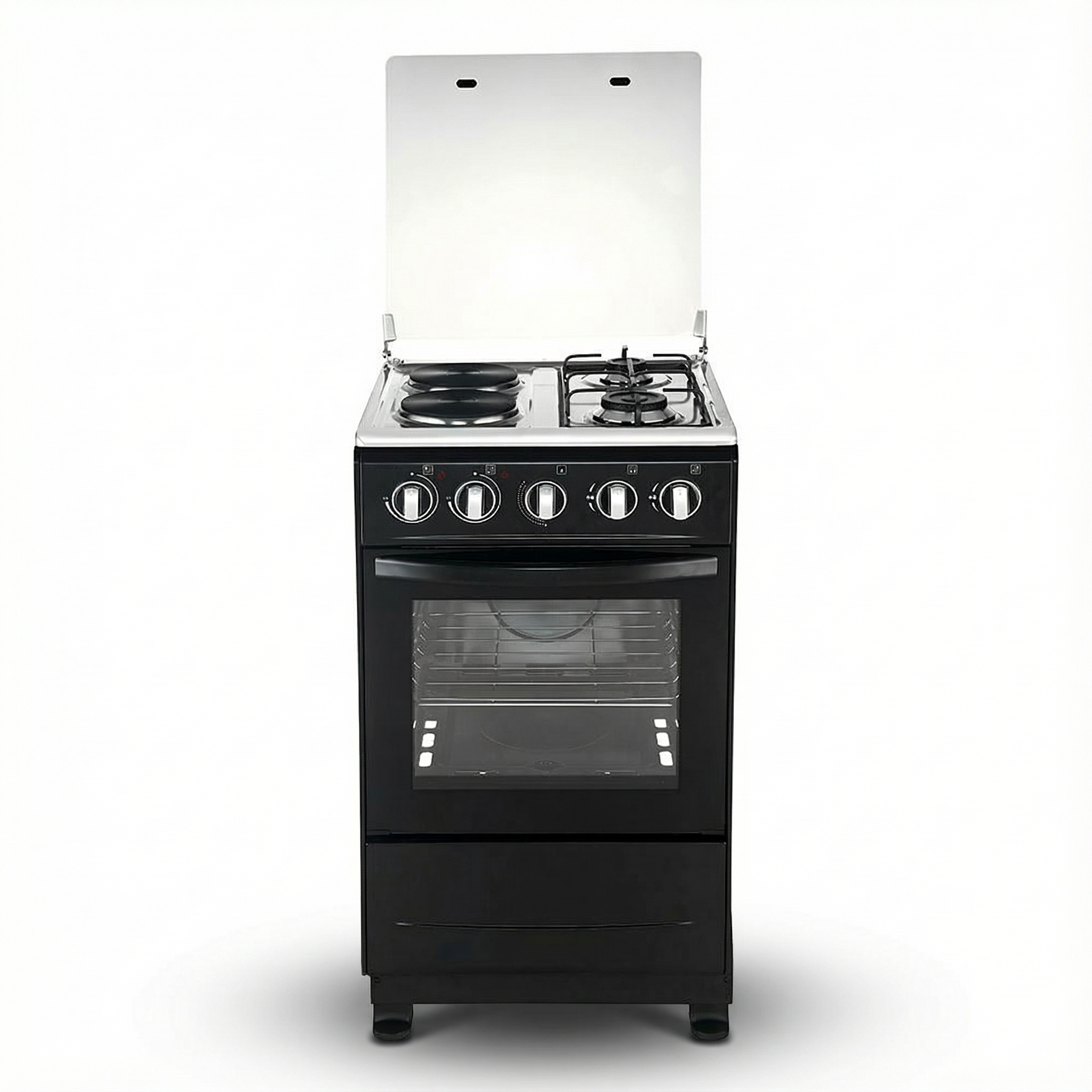
Engineers designed the gas electric freestanding cooker to resolve the single-fuel dilemma. This architecture physically isolates the gas delivery system from the high-voltage electrical components. The top manifold distributes regulated gas to the surface burners through individual mechanical valves. Meanwhile, a heavy-duty electrical circuit powers the hidden baking elements, broilers, and convection fans located in the lower cavity.
Manufacturers offer these appliances in three distinct form factors. Freestanding models feature finished side panels and a raised rear control backguard. They slide easily into any standard cabinet cutout and push flat against the wall. Slide-in models lack the rear backguard. Their controls sit on the front fascia, creating a seamless, flush look against your custom tile backsplash. Pro-style ranges emulate commercial restaurant equipment. They boast heavy-duty cast metal knobs, massive interior capacities, and industrial stainless-steel aesthetics.
You must weigh the spatial trade-offs of a unified appliance against installing separate units. Installing a separate gas cooktop and an electric wall oven requires significant cabinet modifications. You lose valuable lower drawer storage space under the drop-in cooktop. You also sacrifice tall pantry space to house the wall oven. A unified hybrid unit consolidates your cooking zone into one vertical footprint. It maximizes your available cabinetry while delivering identical culinary performance.
Appliance Configuration Comparison
Configuration Type | Space Requirement | Installation Complexity | Aesthetic Integration |
|---|---|---|---|
Freestanding Hybrid Range | Standard 30" to 36" cutout | Moderate (requires both utility connections in one spot) | Traditional, visible rear control panel |
Slide-In Hybrid Range | Standard cutout, overlapping counter edges | Moderate to High (precise counter leveling needed) | Modern, flush with backsplash, front controls |
Separate Cooktop & Wall Oven | Requires two dedicated cabinet zones | High (split utility routing, custom cabinetry) | Highly customized, ergonomic oven placement |
Burner power directly dictates your cooking capabilities. Professional-grade models feature high-output burners generating between 18,000 and 25,000 BTUs. You need this intense heat for authentic wok cooking, where rapid moisture evaporation is required to prevent food from steaming. High BTUs rapidly boil large stockpots and deliver restaurant-quality sears on thick cuts of meat. Standard residential burners simply cannot recover heat fast enough when you add cold ingredients to a hot cast-iron skillet.
Power means nothing without control. You must evaluate the simmer capabilities. Premium models utilize dual-stacked burners. Two separate gas rings operate independently on the exact same burner head. The upper ring delivers the high heat, while the lower ring maintains ultra-low temperatures around 140°F. This allows you to melt chocolate or hold delicate hollandaise sauces for hours without scorching the bottom of the pan.
Grate design impacts daily usability and safety. Look for continuous cast-iron grates across the entire cooking surface. They allow you to slide heavy, liquid-filled pots from a front high-heat burner to a rear simmer burner without lifting. The cast iron retains heat well and provides a stable, non-slip foundation for all cookware sizes. Some manufacturers coat these grates in porcelain enamel to prevent rusting and make dishwasher cleaning possible.
Burner Material Comparison
Burner Material | Heat Tolerance | Durability | Maintenance |
|---|---|---|---|
Cast Aluminum | Moderate | Prone to warping over decades of high heat | Easy to clean, lightweight |
Solid Brass | Extremely High | Resists thermal expansion and deformation | Develops a natural patina, requires specialized polish |
The electric oven cavity represents the core advantage of this appliance. You should prioritize models featuring True European Convection. Standard convection merely places a fan inside the oven to circulate ambient heat generated by the lower bake element. True European Convection wraps a third, dedicated heating element directly around the fan assembly. This blows pre-heated air throughout the cavity. It ensures uniform heat distribution across multiple racks, eliminating cold spots and allowing you to bake three trays of cookies simultaneously without rotating them.
Electric elements create a dry baking environment. This dry heat accelerates the Maillard reaction on the surface of your food. It creates superior, flaky crusts on artisan breads. It delivers better caramelization on roasted vegetables and meats. You cannot replicate this dry, consistent heat in a standard gas oven.
Do not rely solely on stated capacity measurements found on specification sheets. You must evaluate the usable interior dimensions. Check the rack positioning options. Ensure the cavity depth accommodates commercial-size half-sheet pans. Some manufacturers inflate capacity numbers by measuring unusable space near the upper broiler element. Bring your largest roasting pan to the showroom to verify actual clearances.
Measure the distance from the lowest rack position to the top broiler element.
Verify the width between the rack glides to ensure standard baking sheets fit horizontally.
Check the extension capability of telescopic racks under heavy loads.
Installing a hybrid cooking and baking appliance demands significant infrastructure. Standard gas ranges only require a standard 120V outlet to power the digital clock and spark igniters. A hybrid unit requires a dedicated 240V circuit. You will typically need a 30-amp to 50-amp double-pole breaker, depending on the oven's total wattage. This requires running heavy-gauge copper wire (such as 8/3 or 6/3 Romex) from your main electrical panel to the kitchen. Retrofitting an older home's electrical panel to support this load requires a licensed electrician and strict permit compliance.
Your gas supply must meet specific volume and pressure requirements. Pro-style stovetops draw massive amounts of gas when all burners operate simultaneously. You usually need a 1/2-inch or 3/4-inch black iron gas supply line. Contact your local utility provider before purchasing. Verify that your current residential gas meter can support the aggregate BTU demand. Natural gas pressure is typically measured in inches of water column (usually 5 to 7 inches). An undersized meter or narrow pipe will cause pressure drops, resulting in weak flames and poor performance when multiple burners are active.
Many homes operate on liquid propane rather than natural gas. Most manufacturers offer LP conversion kits. A certified technician must install these kits. They replace the burner orifices and adjust the pressure regulator. Liquid propane is denser and contains more energy per cubic foot than natural gas. Note that converting to LP typically results in a slight reduction in maximum BTU output due to the different energy density and flow characteristics of the fuel.
High-output burners generate immense heat, grease, and combustion byproducts. Proper ventilation is a strict requirement, not an optional accessory. You must calculate the necessary CFM (Cubic Feet per Minute) for your range hood. The standard industry formula dictates 100 CFM for every 10,000 BTUs of total cooktop output. A 60,000 BTU cooktop requires at least a 600 CFM hood. You must also use rigid galvanized steel ducting rather than flexible foil ducts to prevent grease accumulation and fire hazards.
High-CFM hoods introduce secondary building code requirements. When a hood exhausts more than 400 CFM, it creates negative pressure inside the home. This can cause dangerous backdrafting. Carbon monoxide from your furnace or water heater could be pulled back into your living space. Municipal codes often mandate the installation of a make-up air system. This system automatically opens a motorized damper to bring fresh air inside whenever the hood operates.
You must strictly adhere to combustible clearance requirements. Manufacturers specify exact minimum distances between the range and adjacent cabinetry. You must also maintain proper vertical clearance to unprotected overhead cabinets, typically 30 to 36 inches. Failing to follow these guidelines creates a severe fire hazard and will cause your installation to fail municipal building inspections.
Gas appliances require proactive safety measures. Building codes mandate an accessible gas shutoff valve. This valve must be located immediately behind or adjacent to the appliance, on the same floor, and in the same room. You must know its exact location. Educate everyone in your household on how to recognize the smell of mercaptan. Utility companies add this distinct, sulfur-like odorant to naturally odorless natural gas to warn you of leaks.
Even with proper ventilation, gas combustion produces trace amounts of carbon monoxide. The high output of these stovetops increases this risk. You must install hardwired carbon monoxide detectors in the kitchen and adjacent living spaces. Test these detectors monthly. Replace their backup batteries annually to ensure continuous monitoring.
Verify the gas shutoff valve operates smoothly without requiring a wrench.
Apply a liquid leak detector solution to all threaded pipe joints after installation.
Ensure the anti-tip bracket is securely fastened to the floor or wall studs.
Confirm the 240V receptacle is properly grounded to the main electrical panel.
You must acknowledge the financial reality of this upgrade. A dual fuel gas range carries a premium over single-fuel models within the exact same brand tier. This premium reflects the complex engineering required to safely house two distinct energy systems in one box. You are essentially purchasing a high-end gas cooktop and a premium electric wall oven merged into a single chassis.
Evaluate the component lifespan carefully. Mechanical gas valves generally offer decades of reliable service. They rarely fail. However, the electronic control boards governing the electric oven are susceptible to heat degradation. The hybrid nature means you have twice as many distinct systems that could potentially require service. Look for brands with proven track records for electronic reliability and robust heat shielding between the oven cavity and the digital displays.
Diagnostic complexity increases with hybrid models. If the appliance malfunctions, repairing it often requires a highly specialized technician. The repair professional must be certified in both combustible gas systems and high-voltage electrical diagnostics. Finding a qualified technician in rural areas can be challenging and expensive.
Daily maintenance differs between the two zones. Sealed gas burners prevent spills from entering the internal manifold, making stovetop cleanup straightforward. Open burners offer better oxygen flow for combustion but require meticulous cleaning of the drip pans below the grates. For the oven cavity, evaluate the self-cleaning features. Traditional pyrolytic self-cleaning uses extreme heat to turn baked-on food to ash. Newer steam-clean cycles use lower temperatures and water to loosen debris, which puts significantly less thermal stress on the electronic control boards.
Measure your exact cabinet cutout dimensions, including depth, width, and adjacent combustible clearances.
Audit your main electrical panel to confirm you have physical space and load capacity for a dedicated 240V, 30-50 amp double-pole breaker.
Verify your residential gas meter capacity with your local utility provider to ensure it supports the total BTU load.
Calculate your required hood CFM based on the total burner output and determine if a make-up air damper is required by local building codes.
Inspect your existing gas line diameter to ensure it utilizes 1/2-inch or 3/4-inch black iron pipe.
A: Yes. Unlike standard all-gas ranges that only need a standard 120V outlet to power the clock and spark igniters, hybrid models require a dedicated 220V/240V circuit. This high voltage is necessary to power the heavy-duty electric heating elements and convection fans inside the oven cavity.
A: It offers objective superiority for baking. Electric ovens provide dry, consistent heat that is ideal for crust formation and even temperature maintenance. While the stovetop performance is identical to an all-gas model, the electric oven eliminates the moisture and temperature fluctuations inherent to gas baking.
A: Yes. Most manufacturers include or offer specific LP conversion kits. A certified technician must install these to change the burner orifices and adjust the regulator. Keep in mind that converting to LP usually causes a slight drop in the maximum BTU output of the burners.
A: Installation costs vary wildly. Basic delivery and connection to existing utilities is relatively inexpensive. However, if you need to hire an electrician to run a new 240V line, a plumber to extend gas pipes, or upgrade your utility meter, installation can quickly add significant expenses to your total budget.
A: You must match the hood to the stovetop's power. The standard rule is 100 CFM for every 10,000 BTUs of total burner output. High-output burners generate substantial grease, smoke, and combustion gases, making a powerful, properly ducted hood essential for indoor air quality.
A: Generally, yes. High-wattage electric heating elements, especially those paired with True European Convection fans, reach target temperatures rapidly. They also recover lost heat much faster than gas ovens after you open the door to check on your food.
A: Take immediate action. Extinguish all open flames. Do not operate any electrical switches or unplug any appliances, as a spark could ignite the gas. Evacuate the area immediately, leave the doors open for ventilation, and call your local gas utility provider or 911 from outside the home.


