

close
Choose Your Site
Global
Social Media
Views: 0 Author: Site Editor Publish Time: 2026-10-12 Origin: Site


Relocating to a new property or upgrading your kitchen utility connections often brings an unexpected challenge. You might suddenly realize your current cooker does not match the local gas supply. This common scenario leaves homeowners wondering if they can simply plug in their existing appliance. Are internal mechanical modifications strictly required? Let me speak from years of field engineering experience. A transition from bottled liquid petroleum to municipal natural gas unequivocally demands replacing the internal metering components. In this comprehensive guide, we will explore exactly why these tiny brass fittings dictate the safety of your kitchen. We will break down the science behind fuel combustion and explain how this highly technical transition is executed safely.
Nozzle Replacement is Mandatory: Transitioning from Liquefied Petroleum Gas to Natural Gas strictly requires swapping the injector jets to guarantee safe and balanced fuel flow.
The Physics of Orifice Size: Liquid petroleum operates at a substantially higher pressure and possesses a denser calorific value than natural methane. Therefore, its nozzles feature microscopic holes. Conversely, natural gas requires larger orifices to permit adequate volume at a much lower delivery pressure.
Severe Safety Hazards: Operating an appliance with incorrect jets is not just inefficient. It can trigger dangerous gas leaks, massive uncontrollable yellow flames, heavy soot accumulation, or weak flames that easily extinguish and leak carbon monoxide.
Beyond a Simple Swap: A legally compliant and safe conversion extends beyond merely replacing brass fittings. It inherently involves meticulously adjusting the bypass screws to calibrate the simmer rate and performing rigorous leak diagnostics.
Professional Intervention: Strict local building regulations and warranty conditions typically mandate that a certified gas engineer execute or officially commission the modification.
Before diving into the mechanics, let us look at the broader market landscape. Urban expansion and the modernization of utility grids are rapidly shifting residential energy consumption. We are seeing a massive transition from bottled petroleum to piped municipal gas across developing and established suburbs alike. This macro trend forces appliance engineering to adapt. Manufacturers are moving away from rigid, single-fuel architectures.
Modern consumer demand dictates versatility. Today, premium cooking appliances are designed with adaptive gas manifolds. This means the core chassis remains identical, but the internal brass fittings can be swapped to match the available utility. This engineering shift drastically extends the lifespan of kitchen appliances and reduces electronic waste, ensuring that a high-end kitchen investment remains functional regardless of future utility changes.
The direct, unambiguous answer is an absolute yes. If you are switching your primary cooking fuel source, you must replace the nozzles on your appliance. Attempting to connect a municipal gas supply to a setup calibrated for bottled gas without making these critical internal modifications will lead to immediate appliance failure.
For those unfamiliar with internal appliance mechanics, a gas jet is a diminutive brass hexagonal fitting positioned deep beneath the burner cap and aluminum spreader. It features a precisely drilled central hole acting as a strict gatekeeper. This component meters the exact volume of combustible fuel that enters the burner to mix with ambient oxygen.
From a visual and physical standpoint, the differences between an lpg gas hob nozzle and its natural gas counterpart are distinct. Because they are meticulously engineered to accommodate vastly different chemical properties, their internal hole diameters vary significantly. Manufacturers stamp microscopic numbers on the side or crown of these fittings to denote the orifice size. For instance, a jet stamped with the number 87 features a hole diameter of precisely 0.87 millimeters. When comparing the two side-by-side, you will immediately observe that the aperture in the natural gas jet is visibly wider than the one tailored for liquid petroleum.
To fully grasp why this mechanical adjustment is non-negotiable, we must delve into the fundamental physics and chemistry of combustible fuels. The distinct behavioral characteristics of these gases directly dictate the engineering parameters of modern kitchen appliances.
The initial and most prominent variation lies in the delivery pressure. Liquefied Petroleum Gas, which is typically a refined blend of propane and butane, is highly compressed into a liquid state. It is stored in heavy-duty steel cylinders or large outdoor residential tanks. Due to this extreme compression, it is forced into your appliance at a relatively high pressure. This usually hovers around 28 to 30 millibars for butane, and up to 37 millibars for propane.
In stark contrast, Natural Gas flows directly into urban and suburban homes via a vast municipal utility grid. By the time this gas travels from the street main into your kitchen, internal regulators have stepped the pressure down significantly. This allows the fuel to enter the cooktop at a gentle, low pressure of approximately 20 millibars.
Furthermore, we must consider the calorific value. This metric quantifies the sheer heat energy packed into a specific volume of fuel. Liquid petroleum is an incredibly dense energy source. It contains vastly more thermal energy per cubic meter than standard natural gas.
Appliance engineers rely on a standardized measurement known as the Wobbe Index to calculate and compare the combustion energy output of varying gas blends. Because liquid petroleum boasts a remarkably high Wobbe Index, a much smaller volume is required to generate the exact same thermal output as a larger volume of natural gas.
Consequently, this scientific reality directly determines the required bore size in the brass nozzle. Since natural gas carries less energy per cubic meter and arrives at a sluggish pressure, the nozzle orifice must be substantially larger to allow a sufficient volume of fuel to pass through. Conversely, the high-pressure, energy-dense petroleum demands a highly restrictive, tiny hole to prevent the burner from being dangerously overwhelmed with fuel.
Neglecting to swap the injector jets when transitioning your utility supply is far more than a simple operational oversight. It creates an immediate and severe domestic hazard. The precise mixture of gas and oxygen required for clean combustion will be completely skewed, triggering alarming consequences.
If a homeowner mistakenly connects a municipal gas line to a cooktop still equipped with restrictive propane nozzles, the appliance will essentially be starved of fuel. Because the municipal supply lacks the pressure to force its way through the microscopic orifice in sufficient quantities, the resulting flames will be anemic and weak. You will likely struggle to even ignite the burner. If it does catch, the flame will sputter and blow out at the slightest breeze from an open window. This scenario easily leads to unburned gas silently leaking into the room if the safety thermocouple fails to shut the valve.
In contrast, attaching a high-pressure bottle of liquid petroleum to a cooktop fitted with wide-open natural gas jets represents the most catastrophic scenario. The burner manifold will be instantly flooded with an excessive torrent of highly volatile fuel. The immediate result is a massive, uncontrollable orange or yellow flame that leaps perilously high above the cast-iron grates. Because the volume of gas vastly outstrips the available oxygen, incomplete combustion occurs. This not only produces thick, greasy soot that will rapidly blacken the bottoms of your cookware, but it also generates lethal concentrations of carbon monoxide. This odorless, invisible gas poses a critical threat to human life.
Executing a proper modification requires utilizing specific, rigorously tested components to ensure both optimal cooking performance and absolute safety. Generic hardware store parts are never acceptable in gas appliance engineering.
When altering the fuel intake of your appliance, you must procure a dedicated Original Equipment Manufacturer conversion kit. A standard, factory-approved kit generally contains a complete set of brass jets. These are precision-machined nozzles featuring orifices perfectly calibrated for the specific aerodynamic design of that brand's burners. The kit also includes a mandatory adhesive specification plate that must be affixed over the original factory sticker, legally documenting the modification.
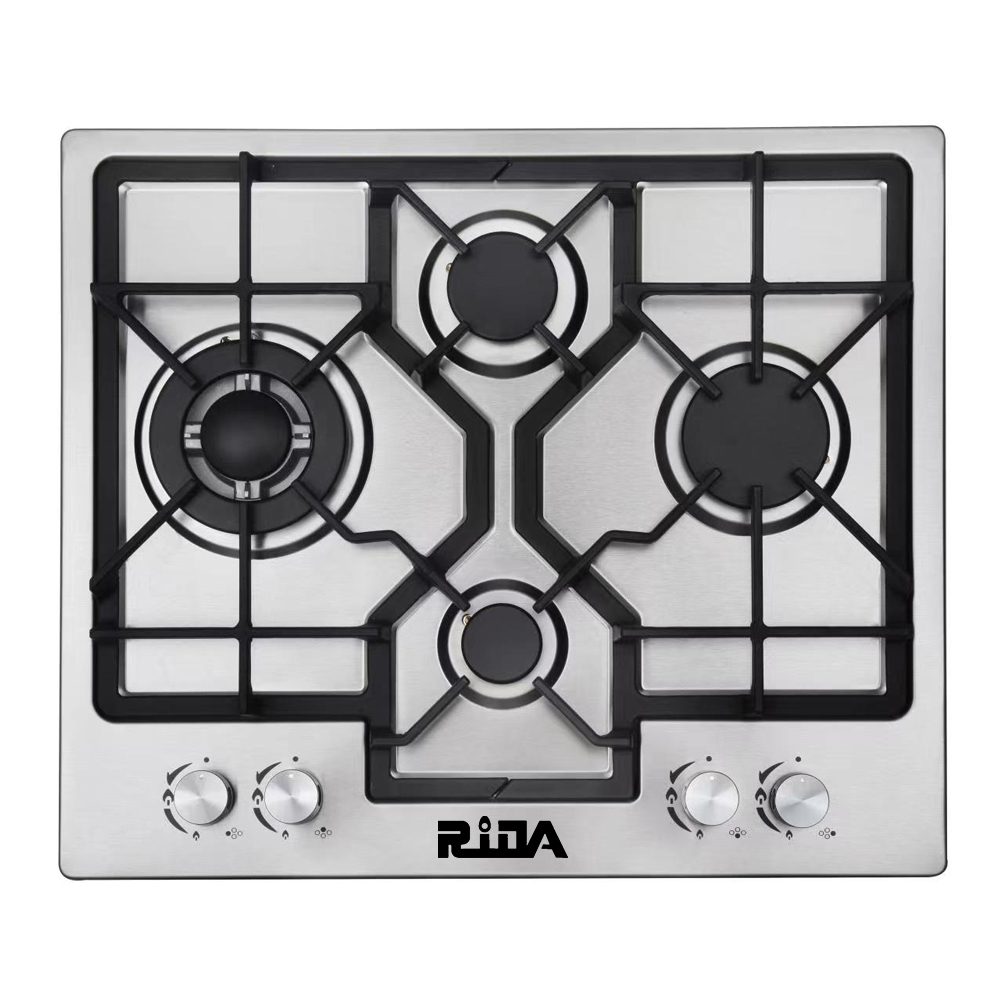
Take a standard high-performance unit like a 600mm 4-burner stainless steel built-in gas hob equipped with heavy-duty cast iron pan supports. This setup does not utilize uniform burners. It features an array of sizes tailored for diverse culinary tasks. You will typically find a 1.0 kilowatt auxiliary burner for gentle simmering, two 1.75 kilowatt semi-rapid burners for standard boiling, and a powerful 3.3 kilowatt wok burner for intense searing.
Each distinct burner demands a specifically sized jet from your conversion kit. Mixing them up is highly dangerous. For instance, accidentally threading a massive wok jet into a tiny auxiliary burner base will trigger an immediate and hazardous flare-up upon ignition. When upgrading your kitchen, sourcing an ng gas hob that provides clear, unambiguous mapping between burner types and their corresponding nozzle sizes is a mark of superior manufacturing.
The following methodology is provided strictly for informational purposes to illustrate the mechanical complexity of the task from an engineering perspective. Gas plumbing is inherently dangerous. Always consult local municipal codes, as the vast majority of jurisdictions legally require a licensed gas fitter to perform these modifications.
Before any tools are retrieved from the toolbox, rigorous safety protocols must be enforced. First, the appliance must be entirely disconnected from the electrical mains to eliminate the risk of the electronic ignition generating a stray spark. Next, trace the gas line to the primary shut-off valve and turn it perpendicular to the pipe to halt all fuel flow. Finally, guarantee the workspace is heavily ventilated by opening cross-breeze windows to disperse any residual fumes.
Carefully remove all heavy cast-iron pan supports, the enameled burner caps, and the underlying aluminum spreaders, setting them aside on a protective towel. Illuminating the center of the burner cup with a flashlight will reveal the brass nozzle threaded into the base block. Utilizing a standard 7 millimeter deep socket wrench, gently unscrew the original high-pressure jets by rotating counterclockwise. It is imperative to maintain the wrench perfectly vertical. Applying lateral pressure can easily snap the soft brass head off, permanently ruining the internal manifold.
Consult your manufacturer technical schematic to pair the correct hob nozzle conversion jet to its designated burner. Gently lower the new fitting into the cup using the socket. Begin threading it clockwise strictly by hand to ensure the fine threads align flawlessly, thereby preventing cross-threading. Once it catches smoothly, tighten it down with the wrench until you feel a firm, satisfying resistance, taking immense care not to over-torque and strip the delicate metal.
This critical calibration phase is frequently bypassed by well-meaning amateurs, resulting in appliances that function poorly on low heat. Swapping the main jets only dictates the maximum fuel flow. To correct the minimum simmer rate, pull the plastic control dials straight off their shafts. Located either directly down the center of the hollow brass shaft or immediately adjacent to it is a microscopic bypass screw.
Restore the gas and electrical supply, ignite the burner, and immediately turn the dial to its lowest possible setting. Using a precision flathead screwdriver, meticulously rotate the bypass screw. Turning it counterclockwise typically increases the flow, while clockwise restricts it. The ultimate goal is to sculpt a crisp, stable blue flame that gracefully wraps the burner cap and refuses to extinguish even when you violently twist the control knob from maximum back to minimum.
Once reassembly is complete, a clinical leak test is non-negotiable. Generously apply a certified, foaming gas leak detection fluid around the base of every newly installed nozzle and any disturbed pipe unions. Monitor the area intently. The formation of expanding, soapy bubbles is a glaring indicator of a dangerous leak that requires immediate tightening. Never use a lighter or open flame to check for escaping gas.
Precision engineering is the cornerstone of safe gas appliance operation. Comprehending how these tiny components are sized guarantees that the cooktop operates at peak thermal efficiency without compromising household safety.
As previously noted, nozzles bear stamped digits that correspond directly to their orifice diameter measured in hundredths of a millimeter. Determining the correct size relies entirely on the burner maximum thermal output rating, generally calculated in kilowatts.
For example, a standard 3.0 kilowatt rapid burner might operate flawlessly on an 87 jet, meaning 0.87 millimeters, when fueled by pressurized petroleum. However, once transitioned to the sluggish pressure of municipal methane, that exact same burner will demand a significantly wider 115 jet, meaning 1.15 millimeters, to maintain its 3.0 kilowatt output.
Burner Classification | Approximate Thermal Output | Standard Propane Jet at 37 millibars | Standard Methane Jet at 20 millibars |
|---|---|---|---|
Auxiliary Simmer | 1.0 kilowatts | 50 or 0.50 millimeters | 72 or 0.72 millimeters |
Semi-Rapid Standard | 1.75 kilowatts | 65 or 0.65 millimeters | 97 or 0.97 millimeters |
Rapid High Heat | 3.0 kilowatts | 85 or 0.85 millimeters | 115 or 1.15 millimeters |
Wok Triple Ring | 3.3 kilowatts | 95 or 0.95 millimeters | 125 or 1.25 millimeters |
Technical experts strongly advise avoiding generic universal conversion kits marketed online. While the external 7 millimeter hex head might be an industry standard, the actual thread pitch frequently varies between competing brands. Forcing a universal jet with mismatched threads into your manifold will irreparably carve new grooves into the soft aluminum, resulting in insidious, undetectable gas leaks beneath the cooktop surface.
The culinary appeal of a dual fuel cooker lies in its hybrid nature. It marries the instantaneous, visual heat control of a gas surface with the incredibly consistent, dry baking environment of an electric convection oven. This hybrid architecture introduces specific nuances during a fuel transition.
When executing a fuel conversion on a hybrid appliance, the mechanical modifications are strictly isolated to the upper cooktop tier. The internal gas manifold exists solely to feed the surface burners. There is absolutely no need to dismantle the rear chassis or access the oven cavity. However, these hybrid units draw massive electrical current. It is profoundly critical to ensure the heavy-duty breaker switch in your home electrical panel is flipped to the off position before any wrenches touch the gas lines. Even a microscopic static discharge near an open gas pipe can incite a devastating flash fire.
While internet video platforms are saturated with tutorials portraying nozzle swaps as breezy weekend projects, the stark legal and safety realities governing combustible gas modifications paint a much stricter picture.
From a strict liability perspective, altering the internal fuel delivery system of a manufactured appliance fundamentally changes its factory certification. The overwhelming majority of appliance manufacturers explicitly declare in their warranty documentation that any internal gas modifications must be executed by a certified, licensed technician. Attempting this task yourself instantly and permanently voids your warranty coverage.
To guarantee absolute operational safety and legal compliance, contracting a certified professional is the only recommended path. These specialized technicians arrive equipped with calibrated digital manometers to precisely measure static and dynamic line pressures. They possess the expertise to perform legally mandated tightness tests on your home gas infrastructure, ultimately issuing a formal certificate of compliance that protects your property value and insurance standing.
A fuel transition undeniably and always requires the replacement of the cooktop internal nozzles. This precise mechanical adjustment ensures your appliance safely adapts from handling highly pressurized, energy-dense bottled gas to accommodating the lower pressure and higher volume demands of municipal utility grids. Because the margin for error is virtually nonexistent, gas appliance modification must never be treated as a casual experiment. Precision engineering, meticulous bypass valve calibration, and rigorous leak diagnostics are absolutely paramount.
Absolutely not. Gas injectors are precision-engineered components machined down to the hundredth of a millimeter to ensure perfect aerodynamic flow within the Venturi tube. Attempting to manually widen the hole with a power drill will create jagged edges and an asymmetrical orifice. This inevitably results in turbulent, uneven gas flow, highly inefficient combustion, and the severe risk of generating lethal carbon monoxide gas in your kitchen.
No, they are highly specific. While a large portion of the appliance industry utilizes a standardized 7 millimeter hexagonal outer head to allow for easy extraction with standard tools, the internal orifice diameter varies drastically. The required hole size is dictated by a complex calculation involving the specific gas type, regional utility pressure standards, and the exact kilowatt output rating of that individual burner.
A flawlessly converted and precisely calibrated cooktop should produce a sharp, steady, and vibrant blue flame that anchors firmly to the base of the burner cap. If you observe lazy, flickering flames with large yellow or orange tips, the gas-to-air mixture is dangerously incorrect. This visual warning indicates either the installation of an incorrectly sized nozzle or a bypass valve that requires immediate professional recalibration.
Under no circumstances should you operate the appliance without the correct conversion. Using the wrong nozzles even once can lead to immediate and severe consequences, ranging from massive soot production and carbon monoxide poisoning to dangerous, uncontrollable flare-ups. You must wait until the proper conversion kit is professionally installed and tested.
The cost varies depending on your region and the specific appliance model. Generally, the manufacturer conversion kit itself is relatively inexpensive or included in the box with premium models. The primary cost comes from the labor of hiring a certified gas engineer. You can typically expect to pay for one to two hours of professional labor, which is a necessary investment for your household safety and warranty validity.
Yes, the mechanical conversion process is entirely bidirectional and reversible. Provided you safely store the original, smaller jets in a sealed bag, a certified technician can easily revert the appliance. The reverse procedure involves extracting the wide municipal jets, reinstalling the restrictive high-pressure jets, recalibrating the bypass valves to handle the intense pressure increase, and conducting a fresh round of rigorous leak diagnostics.
Ready to upgrade your kitchen with a safe, versatile, and high-performance appliance? Whether you rely on bottled propane or municipal methane, choosing the right equipment is the first step to culinary excellence. Explore our premium range of built-in cooking solutions, including versatile stainless steel models equipped with heavy-duty cast iron supports. Visit Ridax Cooker today to find the perfect, conversion-ready appliance engineered for your specific utility needs.


